
It’s bad enough that our leafy college campuses were in recent memory the midwives of wokery — a culture that’s still rampant across Canadian institutions to this day — but their begetting the malformed triplets of diversity, equity, and inclusion (DEI) into mainstream corporate life has become a full-frontal assault on Western meritocracy. A forthcoming report by the Aristotle Foundation, of which I am an author, reveals that Canada’s top private-sector enterprises are littered with such ideological nonsense.

Time to sit and watch it burn? Daniel Plainsview, played by Daniel Day-Lewis, watches the destruction of an oil derrick in Paul Thomas Anderson’s period drama, There Will Be Blood (2007).
What’s far worse, though, is when a giant global pharmaceutical firm decides to stamp out the fresh shoots of dissent at our leading universities when professors, like myself, who risk criticising DEI and its high priests, highlight how men are now demonstrably outnumbered in higher education, most notably within the student body and across the academic administration.
The University of Toronto (UofT) is Canada’s undisputed number one seat of higher education, a hallowed institution for enquiring minds that champions the academic freedom of its many brilliant and outspoken thought-leaders. Yet such institutions are also paradoxically bilious about undesirable boat-rocking, as exemplified in the case of Professor Jordan Peterson, when the avuncular polymath catapulted to international fame over his now-but-not-then perfectly reasonable objection to everyone being coerced into absurd linguistic gymnastics at the behest of the insufferable pronoun warriors.
Even today, I shudder when I receive an email from my Faculty Association’s appointed lawyer at Goldblatt Partners, or let my eyes stray down to the bottom of a communication from Bank of Montreal, who handle my investments. There, as always, are the pernicious pronoun declarations smirking back at you, stubborn as they are irrelevant.
Of course, Peterson was the proverbial canary in the academic coal mine, a sharp-eyed soothsayer warning of the clandestine assault on freedom of speech that has swept across the English-speaking nations over the past decade. Until that moment the siege had largely gone unchallenged in the face of a near apocalyptic wave of virtue signalling in the name of human kindness and championed — much to my own unremitting chagrin — by platoons of dim-witted, ivory-towered intellectuals.
At our Canadian universities, UofT in the vanguard, those in power declare that freedom of expression is a fundamental tenet of these institutions; but at what price? Today, such principles are, in truth, bought cheaply. In fact, in recent years, universities have become remarkably adept at censorship, with the result that quadrangles have become burgeoning intellectual graveyards, littered with the ghoulish post-cancellation remains of a growing number of notable academics. Think Frances Widdowson, for instance.
On the rare occasion that a lone-wolf academic peers over the parapet, the fallout can resemble a retaliatory broadside of eye-opening proportions. That’s what happened when the head of one of the nation’s biggest pharmaceutical firms, Roche Canada, penned a letter raising “concerns” over an article that appeared in the National Post in October 2024, one that lamented the widespread feminization of higher education — a fact already well-documented by scholars such as Heather Mac Donald and Helen Andrews.
Freedom of information requests filed in 2025 revealed the letter, dated 12 November 2024, was authored by Brigitte Nolet, Roche’s President and CEO. Nolet, who studied English professional writing at University of Waterloo, followed by a stint at Queen’s business school, is the kind of top talent you might expect to have risen to the pinnacle of Canada’s leading purveyor of monoclonal antibodies — drugs for cancer and autoimmune disease. Some readers on my side of the Atlantic might well style Nolet as a Canadian doppelganger of Rachel Reeves, Britain’s incumbent and first-ever female Chancellor of the Exchequer, and nod sagely.
In the letter, addressed to campus bigwigs at the UofT’s Mississauga campus (UTM), Nolet expresses her dismay that an article claiming men are now outnumbered at universities by their female counterparts “diminishes the historical barriers women have faced and undermines the progress they have made”.
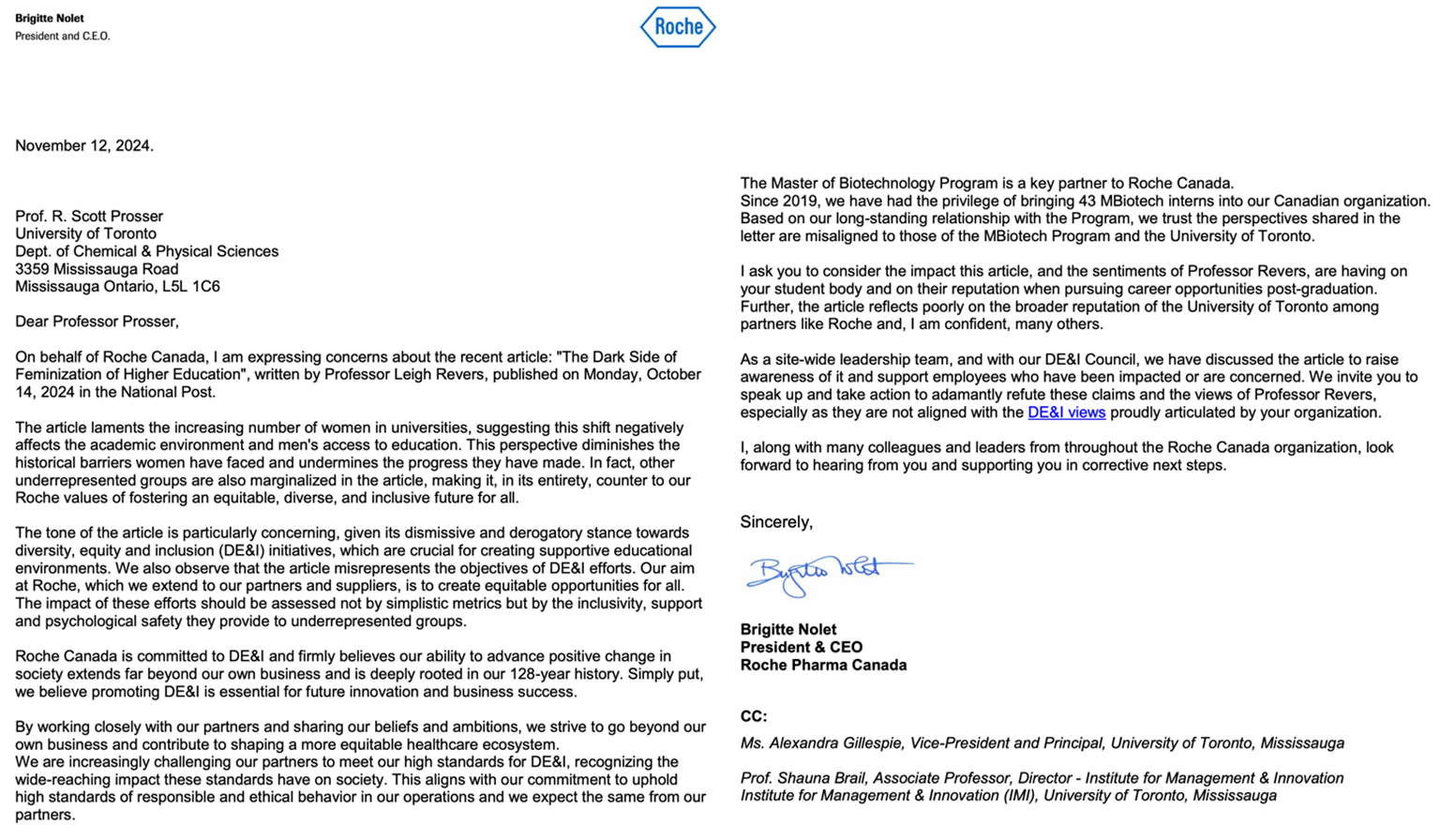
Letter from President and CEO of Roche Canada, Brigitte Nolet, to Professor Scott Prosser, dated 12 November, 2024. Released by the University of Toronto in response to Freedom of Information requests.
According to her, the article is “dismissive and derogatory [towards DEI] initiatives, which are crucial for creating supportive educational environments” — a position doubtless informed by her deep (but sadly uncredentialled) insight into the corpus of university pedagogy.
Nolet’s next salvo — doubtless accompanied by the imperceptible sound of administrative feet shuffling quickly aside — is on point. “Roche Canada is committed to DE&I [sic] … By working closely with our partners … we strive to go beyond our own business and contribute to shaping a more equitable healthcare ecosystem … and we expect the same from our partners.”
Remarkably, a pharmaceutical multinational minding its own business is simply not good enough these days. Apparently, if the utterances of Roche’s CEO are to be taken at face value, all of healthcare in Canada requires refashioning under corporate supervision. That’s the kind of sentiment that ought to cause so many Canadian eyebrows to shoot up in unison as to topple even a Liberal government.
After identifying the University’s Master of Biotechnology (MBiotech) program — the graduate outfit I used to direct — as one such partner, Nolet calls on administrators “to speak up and … adamantly refute these … views”.
Cue deafening silence? Or rapturous applause? To be frank, I’m humbled that some observations of mine have cut to the quick so deeply. Could it be the lady doth protest too much?
Nolet, who in emails thoughtfully uses the triplet pronouns she/her/elle, is quick to remind her audience — including UTM’s principal, Alexandra Gillespie — that, since 2019, Roche has welcomed under its capacious skirts 43 graduates from MBiotech, one of that campus’s premium hot-ticket professional programs.
Without the faintest hint of self-consciousness, the letter goes on to implore administrators “to consider the impact this article, and the sentiments of Professor Revers, are having on [the] student body and on their reputation when pursuing career opportunities post-graduation.”
There’s so little lost in translation here that reading between the lines is needless. The implication could not be any clearer, even if Nolet were to resort to communicating in Braille.
In her sign-off, Nolet enthuses about “supporting [administrators] in corrective next steps”. which is the kind of language that has the same effect on university bureaucrats as scenting a hound to its prey, their fingers ever itching to pull the trigger on any number of ludicrous and wasteful “investigations”. Knowingly or not, Nolet is prodding the self-appointed Stasi of academia.
However, six days later, the mollifying response from MBiotech’s incumbent director, Professor Scott Prosser, wrong-foots Nolet with the sort of sensible claim that infuriates these devout DEI clerics.
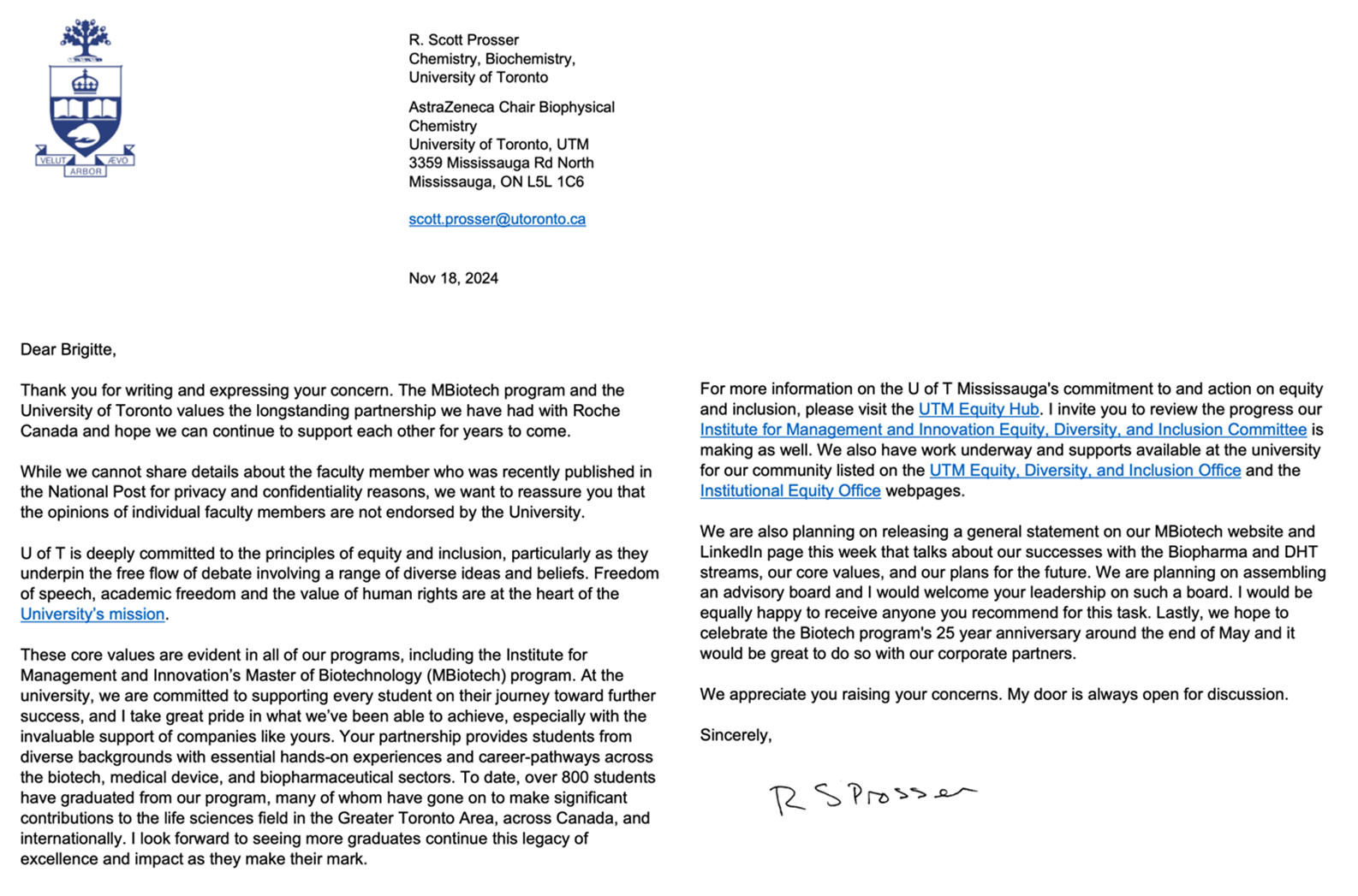
Reply to Brigitte Nolet, dated 18 November, 2024. Released by the University of Toronto in response to Freedom of Information requests.
“[UofT] is deeply committed to the principles of equity and inclusion, particularly … the free flow of debate involving a range of diverse ideas and beliefs. Freedom of speech, academic freedom and the value of human rights are at the heart of the University’s mission.”
Knight to king’s pawn, check.
But within 24 hours this quick-witted riposte was subject to what can only be described as a miserable betrayal when, on 19 November, the MBiotech program posted a director’s statement that at once celebrated 25 years of MBiotech graduates — who, as it happens excel at marketing and selling drugs — and simultaneously affirmed its boilerplate commitment to DEI.
That statement, which in draft form reassuringly (but naïvely) claimed “we don’t ever apply reverse discrimination policies to establish some magical quotient” was quickly doctored by senior administrators, according to emails disclosed by the university. Instead, we got a bland and unimaginative nod to the prevailing mantra, full of the Newspeak lexicon favoured by DEI devotees.
In fact, the public-facing director’s message that was finally published on MBiotech’s website turns out to be both paradoxical and predictable in its claims. “Our program deeply values principles of equity and diversity, continually seeking to foster a community that is inclusive of gender identities and equity-seeking groups, connected to our broader community”, it reads. So far, so tedious.
But the academic Mouth of Sauron continues. “I have […] every desire to maintain excellence in our program.” How reassuring if not arguably unnecessary — declaring anything to the contrary would be academic suicide, after all. Yet this exasperatingly redundant remark blithely overlooks the reality that the very same equity embraced so wholeheartedly just one sentence earlier is entirely antithetical to meritocracy. Advancing people on merit is blind to gender, race, and sexual preference, and hence can never fulfil an equitable utopia that insists on check-box representation and diversity quotas.
What’s worse still, at least for those freethinkers among us, is a director that goes on to “encourage unconscious bias training amongst all staff and colleagues who teach in our program because research demonstrates that diverse teams are innovative teams. Creating a professional and compassionate environment in MBiotech is a priority.”
To all intents and purposes, then, the “cowsheds” described by Chinese scholar, Ji Xianlin — makeshift detainment and re-education centres that sprung up during Mao’s Cultural Revolution — are now being readied for deployment on Canadian university campuses. In fact, I have attended more than one such struggle session myself in recent years, and have written about them.
What’s transparent from all of this is that Prosser’s sentiments about freedom of speech and academic debate — remarks that were polite reactions to busybody interventionism from influential companies like Roche — were quickly steamrollered by the prevailing juggernaut of wokery that passes for modern university administration.
Fortunately, we have arrived in 2026 and there is a change in the air. A stiff breeze is blowing northwards across the Canadian border, one so mighty as to dislodge some of the accumulated dead wood. All of the exchanges I have highlighted predated Donald J. Trump’s repudiation of DEI, which is now spilling over into Canadian corporate life.
What’s more disconcerting about all this absurdity, though, aside from its exposing the ideological rot that persists at the very highest levels in both private and public life in Canada, is the bare-faced collusion aimed at indoctrinating the next generation of Canadians into a belief system that is both unscientific and unmoored from reality.
DEI is a system tied to emotional sentiments about race, gender, and group identity held dear by today’s elites. It is not based in hard facts. Canadians are — I can attest from my very own thirty years of “Northern Exposure” — rather smarter than this; and we all need to recognise just exactly who is trying to conduct the orchestra, especially when those people in positions of power and influence are as tone-deaf as some of the nation’s captains of industry.
Leigh Revers is emeritus professor at the Institute for Management & Innovation at the University of Toronto and Substack author.
Help Ensure our Survival
Comments (0)
Only supporting or founding members can comment on our articles.